As Hawaii Studies Lottery, Key Question Arises
Consultant tells working group it is imperative to determine how tax funds will be used
2 min

As Hawaii lawmakers consider legalizing a state lottery, one consultant told a working group Thursday that the legislature should first identify how it would spend the revenue. The Tourism and Gaming Working Group spent nearly two hours learning and discussing details of implementing a lottery and online gaming programs.
Andrew White, executive director of the North American Association of State and Provincial Lotteries, urged the group to focus on where lottery revenue would go. In some states, lottery or gaming tax dollars are earmarked for education, while in others, it may be for property tax relief or environmental programs. As examples, Colorado sends the bulk of its online gaming revenue to state water projects, and in Nebraska, where stakeholders are moving forward with an online sports betting initiative, funds would be used for property tax relief. Nebraska already has in-person sports betting, and those tax funds are used to defray property tax costs for homeowners.
“I would say, to answer your question about how you would set it up, in my experience in the last 20 years the reason a lottery comes into existence, or is voted into existence, is because of a need,” White said.
Hawaii is one of five states that does not have a lottery. Alabama, Alaska, Nevada, and Utah are the others. In addition, there is no legal gaming in the state, and since the Professional and Amateur Sports Protection Act was overturned in 2018, it is one of about a dozen states that has not legalized some form of sports betting. Despite that, those in Hawaii — as well as those in 48 other states — do have access to de facto sports betting via prediction markets.
Lottery creates jobs, drives in-store buys
With regard to the lottery, White, along with Delaware Lottery Office Director Helene Keeley and problem and responsible gaming consultant Brianne Doura-Schawohl, educated lawmakers about legal lottery and gaming. White shared a presentation describing how lotteries help create jobs and drive in-store purchases at retailers, and he pointed to both as additional benefits beyond tax dollars.
Lawmakers also learned that lotteries may be offered in multiple ways — via in-person ticket purchases, online, or at video lottery terminals — and lottery agencies may have other products, like sports betting, to provide an additional revenue stream. Lottery agencies have a hand in legal sports betting in at least seven states plus the District of Columbia. What that looks like varies — Keeley explained that in Delaware, the lottery directly manages sports betting and also offers its own sports betting product. But in Ohio, the lottery plays more of a supporting role. It handles licensing and regulation but does not offer its own betting product.
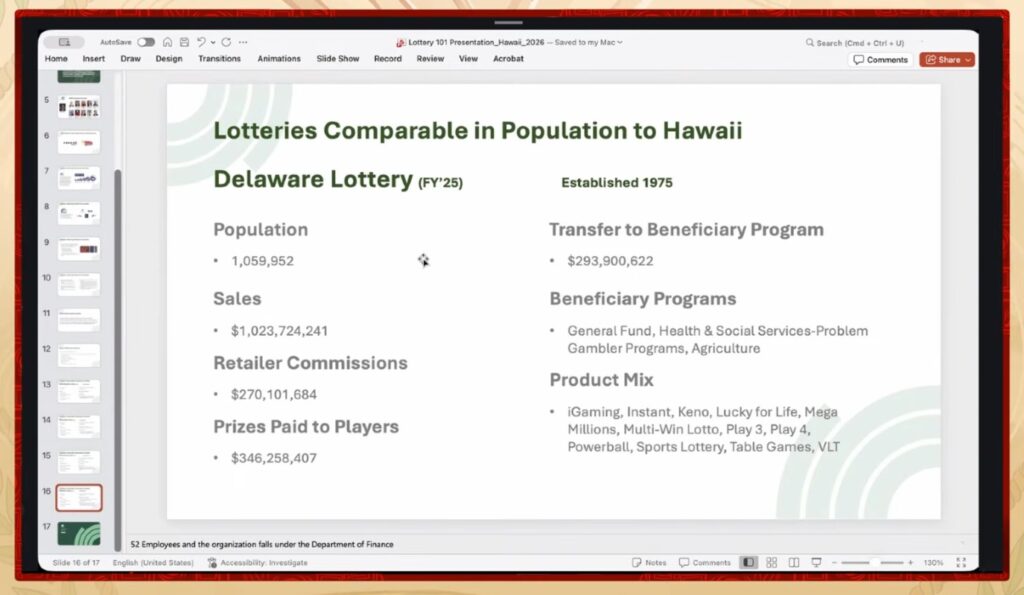
In Washington, D.C., which launched legal sports betting with a single platform operated by the lottery, the city has since switched to a competitive market and tax revenue has more than doubled. The most the city collected during years with a single operator was $9.7 million, and in 2025, it received more than $20 million.
Though revenue statistics have shown that having a single gaming operator — the setup under which Delaware operates — does not bring states the highest level of tax income, Keeley said that it does allow the state more control over what products are out there and accessibility and advertising, all of which she views as a benefit.
Tourism effect?
Members of the Hawaii working group wanted to explore how the state’s tourism industry might have a tie to lottery or gaming sales. Hawaii has a population of about 1.5 million people and welcomes more than 9 million visitors per year. White suggested that the state could offer unique games that might entice visitors to play. One disadvantage for Hawaii, due to its ocean location, is that in areas where multiple states share borders, it is common for lottery players to cross those borders when a lottery jackpot surges.
Hawaii lawmakers have considered adding lottery and online sports betting since at least 2020, but they have been unable to get a bill to the finish line. Previous bills have earmarked lottery or gaming funds for education, including funding for the University of Hawaii system.